The business value of high trust is undeniable – but its human value is priceless.
View in browser
August_FooterWordmark

Welcome to our biweekly newsletter, featuring our latest thoughts, resources & inspirations on organizational change.

I used to think trust between people was ineffable and absolute – either I trust you or I don’t. I knew that trust could be broken or earned, but I never had the sense that trust could be skillfully built. 


Then I read Unleashed by Frances Frei and Anne Morriss. I remember sitting on a bench in Prospect Park, my eyes glued to the page as I absorbed each revelation of their Trust Triangle like a punch to the gut.

R2003H_FREI_TRIANGLE

Trust suddenly had specificity, shape, dimension. I no longer saw it as a relational je ne se quoi, but as a discipline you can learn. It takes practice, self reflection, and understanding, but we’re all capable of getting better at building trust.


And there are plenty of reasons to try – especially in a business context. Research shows that trust drives productivity while decreasing drag on everyday operations. And an astonishing 93% of business executives agree that “the ability to build and maintain trust improves the bottom line.”


But for me, as strong as the business case for trust may be, the human case is even more compelling.


We should care about how people feel working in our organizations. And I know from personal experience that working in a low-trust environment feels terrible. It’s disengaging and disheartening. It can even be physically stressful! I still carry memories of what it felt like when a colleague failed to show me genuine care, or didn’t walk the talk, or showed questionable judgment.


People who work at high-trust companies, on the other hand, report 74% less stress, 106% more energy at work, 76% more engagement, 29% more satisfaction with their lives, and 40% less burnout compared to people at low-trust companies. If that isn’t reason enough to prioritize trust, I don’t know what is.


I think of trust like a cultural lubricant that reduces friction between people and teams, enabling better decisions, braver experiments, and quicker pivots. 


But lack of trust grinds the gears, creating noise and smoke and waste, slowing everything down and risking catastrophic damage. 


So how do we get better at building trust? 


First of all, we need to resist the temptation to simplify trust into a technical problem with a formulaic solution. Trust is interpersonal, not procedural. No matter how precise your processes are, a lack of trust will break those systems every time. 


Secondly, we need to be courageous about finding the root cause of trust issues. This requires us to be willing to dig into our own areas of discomfort and weakness around trust, and have brave conversations with others about how we can build trust over time.


Understanding the cornerstones of trust is the first step in that work. 


Nowadays when I feel frustrated or avoidant with a coworker, I have a framework for understanding it as a trust problem, and the language to diagnose it and start making it better.


Trust has become a lens through which I understand all my relationships, personal and professional. 


Karina Mangu-Ward

Partner, August Public

Download the Building REAL Trust Starter Stack

We're expanding our team! 📣

Were Hiring

We’re hiring Senior Transformation Consultants. (At least, that’s what we call ourselves. You might call this role a Senior Managing Consultant, Engagement Lead, or Principal.)

Come join a group of visionary consultants, working together to help organizations realize their most ambitious goals by building more open, agile and inclusive teams. 🔥

We’re self-managed, flexible, and remote-forward. We work intentionally to build a culture of inclusion and empowerment, and we believe that work-life integration and healthy balance are essential to great performance. 😌 🌿

Learn more & apply!

On the August Blog

When we talk about trust at August we often cite the quote, “Trust is built in teaspoons and lost in buckets.” One teaspoon-y way you can build trust over time is by using thoughtful check-ins. Short or long, silly or serious, a check-in practice can help teams cumulatively build trust and connection over time.


Our resident aficionado Levi Baer has some great advice on how to design an effective check-in. He includes tips for how to choose a check-in that fits the time limits, group size and purpose of the meeting, and gives a lot of great examples. 


Read the blog: The Subtle Art of Checking In

What We're Reading / Watching / Listening To

How Organizations Can Encourage Productive Allyship 🌈

This HBR piece by Hannah J. Birnbaum, Desman Wilson and Adam Waytz discusses how leaders sometimes avoid acts of allyship for fear of “getting it wrong” – and how organizations can encourage allyship through education and culture-building.


Why Trust is Key to High-Performing Teams 📺

Simon Sinek gives a refreshingly candid, story-driven talk on the critical value of trust for organizational excellence and employee success.


In Search of Agility 🤾

Gallup recently found that only 18% of U.S. employees say their company is agile. This article digs into 3 primary barriers that are blocking organizations from becoming more agile, along with the steps leaders can take to fix them.

More Great August Resources! 👀

Our whitepapers, playbooks and videos will help you integrate agile ways of working, operationalize equity and inclusion, and build more engaged and creative teams. And they're all free!

Strategy Sprint Playbook

This 3-day immersive leadership retreat will help you build an actionable strategic plan that not only articulates what the organization intends to achieve, but how they’ll do it, and who will be in charge of leading the work.

Strategy Sprint cover image

Get Better At Decision Making

Each snackable video in this 5-part series tackles an empowered decision-making practice you can use with your teams right away for better decision outcomes and a more inclusive company culture. 👇

Get Better At Decision Making | August Public

Generative AI: Adoption Maturity Model

This holistic framework will help you diagnose your organization’s readiness and capacity for AI transformation, and clarify your path forward across five clearly defined business areas. 👇

AI Maturity Model Newsletter Image

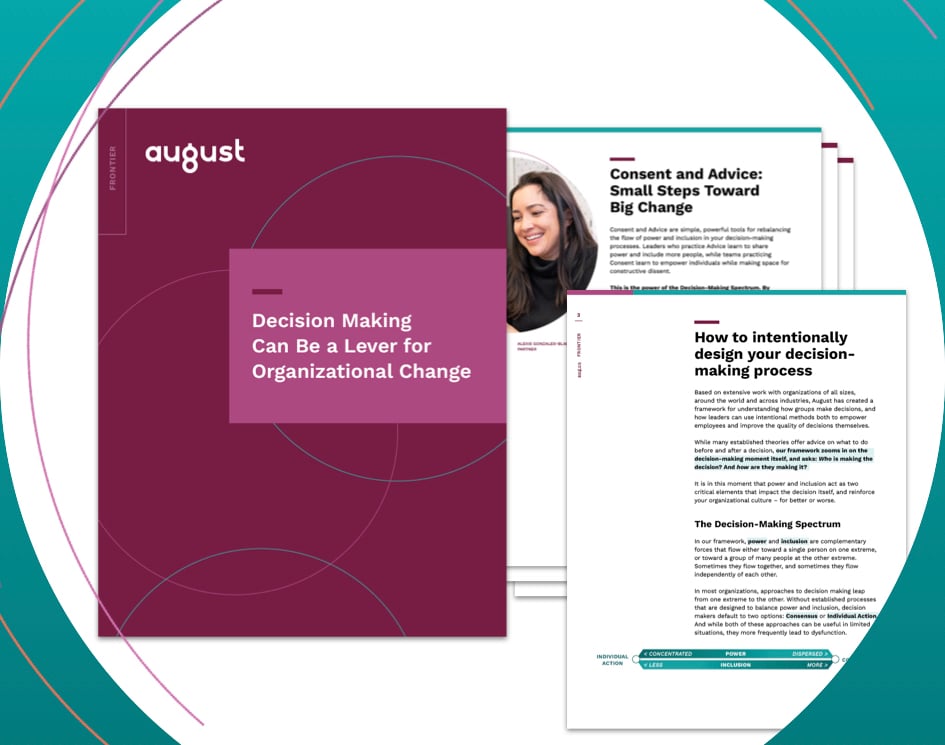
Decision Making Can Be a Lever for Organizational Change

Alexis Gonzales-Black and Mike Arauz share decision-making models that can help you improve decision outcomes while building a more inclusive culture. 👇

decision-making-social.002

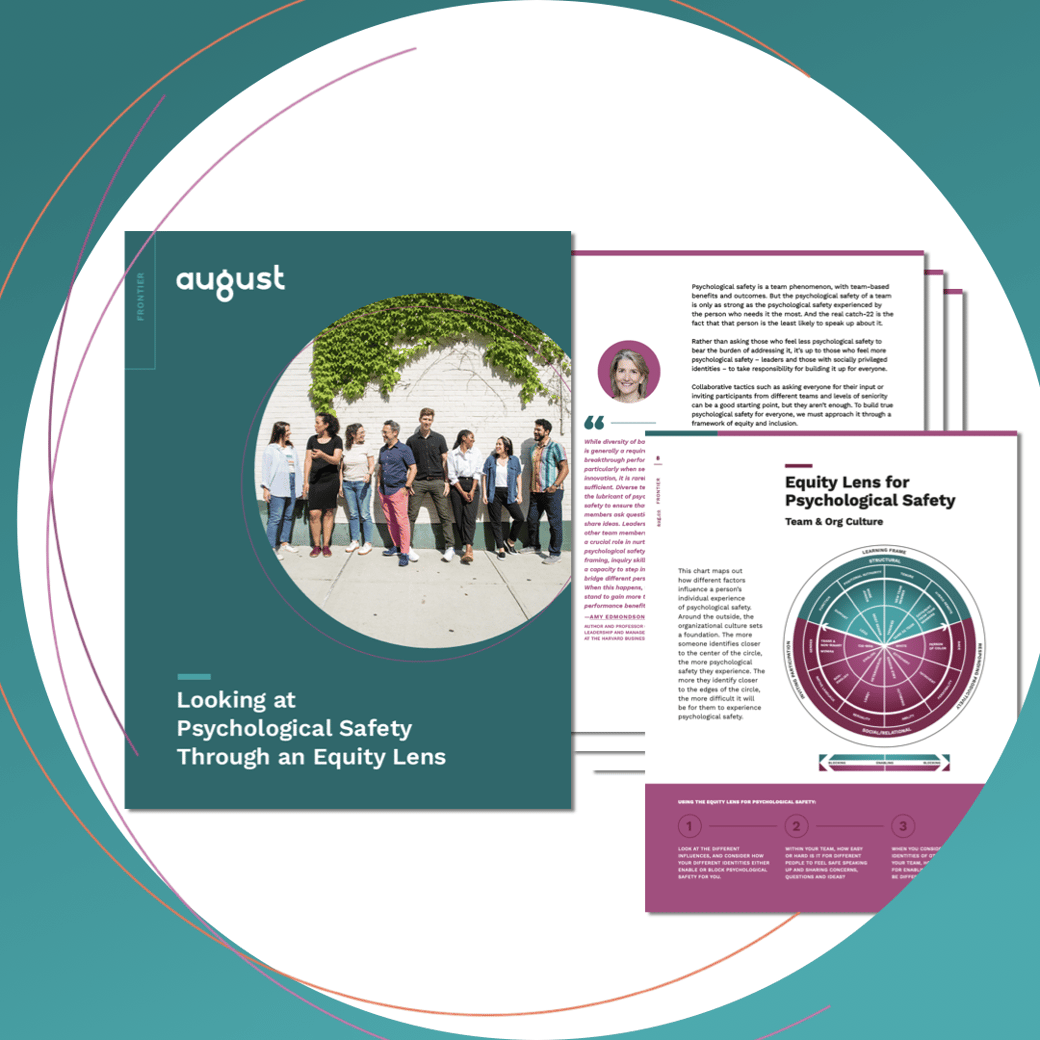
Looking at Psychological Safety Through an Equity Lens

Discover an intuitive tool for building more equitable access to psychological safety that accounts for peoples’ lived experiences and structural power. 👇

equitylens-august-social.001-2

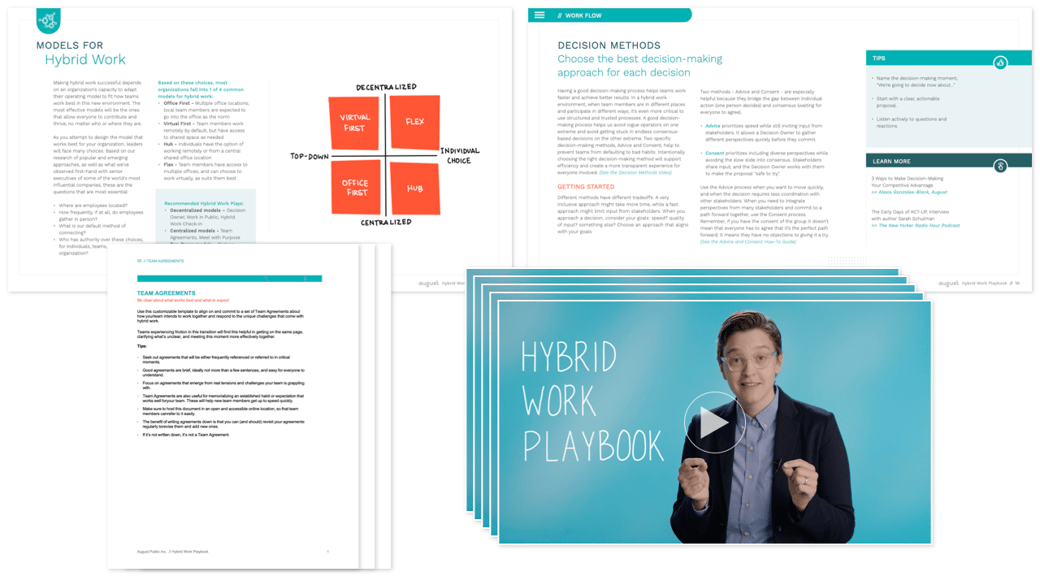
The Hybrid Work Playbook

This self-paced course provides practical tools to help you adapt to hybrid work and build a thriving hybrid culture. 👇

hybrid-promo-thumbnail.001

We're on social. 😎

Follow us on Instagram and LinkedIn for visual insights and practical tips on decision making, learning culture, psychological safety, agile org design, and more.

Screenshot 2023-03-17 at 1.10.23 PM
LinkedIn
Instagram
Website

August Public Inc., 68 3rd St, Brooklyn, NY 11231

Unsubscribe Manage preferences