It’s not often I call something a masterpiece, but there’s no other way to describe Nathan Fielder and Lance Oppenheim’s documentary on Elizabeth Holmes, You Can See Everything.
I saw the doc this weekend (like seemingly everyone else in Brooklyn…that ticket war was no joke), and came away with a lot of thoughts about leadership and trust. Also, a lot of thoughts about edges.
This is a film about the slippery edge between authenticity and artifice. You truly can’t tell if Holmes is being real, even while she is literally saying the words “I’m always being real.”
Whether or not Holmes is trustworthy has always been the big question. As the founder of blood-test company Theranos, she built an empire off a compelling vision, but that same vision got her sentenced to 11 years in prison for defrauding investors.
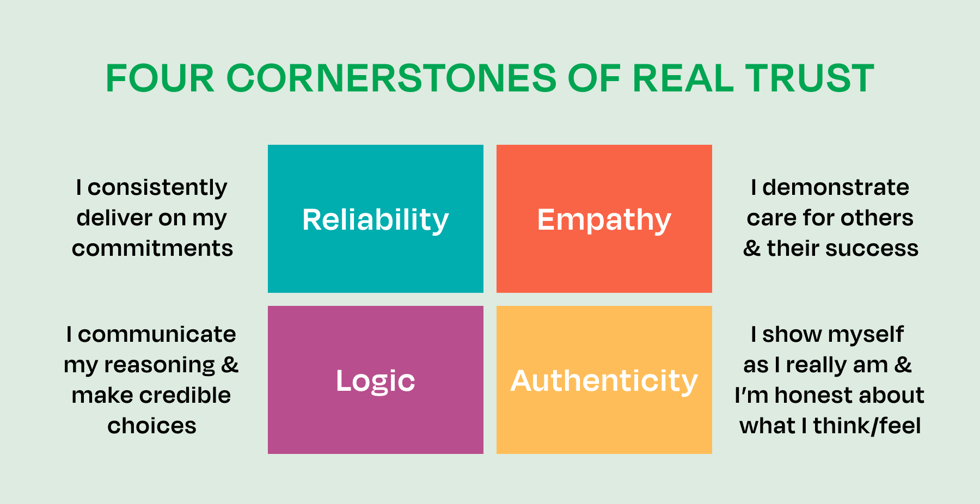
Trust is a non-negotiable for leaders who want to build thriving teams and relationships. August uses the Four Cornerstones of Trust to help cultivate that kind of lasting, real trust. If Holmes is pushing the edges of trust, these would be its core:
Throughout the doc, in which Fielder moves in with Holmes and her family in the weeks leading up to her prison sentence, we see some pretty wild examples of logic and authenticity trust wobbles.
(Mild spoilers incoming! You have been warned!)
There’s a fascinating scene where Fielder shows her the famous Who’s on First comedy routine, known for its tricky, humorous wordplay. But she cannot piece together the logic of the skit, or what’s confusing about it. A real logic wobble. Or maybe she can, and she won’t admit it? That’s an authenticity wobble. I couldn’t quite tell what was happening, but I knew it made me feel very uneasy.
This inability to understand how words and their meanings can bend is the central theme of her fraud case, and the trust wobble that the film depends on.
When she says “we’ve built a machine that can do any test,” she claims her words are true. That Theranos did build a machine that can do any test…eventually. But those same words, which most people interpret as “can do any test currently,” are why she’s accused of fraud.
Your ability to follow Holmes’s logic (or not) and whether you believe she’s being honest (or not) determines whether you leave the theater with any empathy for her (which was her stated goal in agreeing to the film in the first place).
I see this struggle with authenticity manifest in a similar, albeit lighter, way all the time in organizational life. People, especially leaders, will stand up and say authenticity matters, but their everyday behavior says something different.
Just like one sentence can be the edge between truth and fraud, micro-moments at work are often where we gain or lose trust with our team. When we double down on clearly faulty logic, we lose trust. When we listen to how people receive our statements and adjust with openness and honesty, we build it.
The film doesn’t answer any of the questions it poses. Ultimately, it’s about the fact that there are no easy answers when it comes to trust. August, as a firm, can’t answer these questions either. We can’t tell you who’s trustworthy and who’s not.
But we can help you talk more openly about them. Because it’s the reckoning with these tough questions, the acknowledgement, that’s essential to building healthy relationships at work.
We may never know who we can trust, but we can do our best to normalize conversations about trust and work toward strengthening it with our teams.
Karina Mangu-Ward
Partner, August Public
FOOTNOTES
What we’re reading, watching + listening to
AI is Expensive, Teaming is Free feat. Clay Parker Jones 🤖
We love Clay Parker Jones’s ideas, and this podcast is no exception. Listen for great insights on role clarity, psych safety, and why creating better teams is the best thing you could do for your org.
Team Dynamics Weaken When Employees Turn to AI Instead of Colleagues 🫂
Displacing teammates with AI, or “relationslipping,” can harm dynamics and erode trust. This HBR piece offers ways to protect team cohesion while still integrating AI into daily work.
Why Psychological Safety Really Matters for Team Performance 🛟
Amy Edmondson’s latest podcast appearance dives into interpersonal risk and how, when teams feel safe speaking their minds, they are able to focus more seriously on the work.
One way to build trust with your team, especially amidst uncertainty, is the Candid Comms practice.
What it is: Four simple questions that make it easy to share regular updates (even bad ones) in a clear, open way.
How to implement it: When sharing information with your team, answer the following questions:
What is my goal? - Openly share your communication strategy
What do we know? - Share the information you have, no matter how negative
What don’t we know/can’t share? - Be honest about uncertainty or purposeful privacy
What’s our first next step? - Share a proposal on what to do next
This type of transparency, offered up at a regular cadence, will strengthen team trust and communication habits. By modeling directness and honesty, you’ll show your team that these behaviors are safe, leading to more psychological safety. Wins all around!
SAFE TO TRY
Quick tips to start changing how your team works
One way to build trust with your team, especially amidst uncertainty, is the Candid Comms practice.
What it is: Four simple questions that make it easy to share regular updates (even bad ones) in a clear, open way.
How to implement it: When sharing information with your team, answer the following questions:
What is my goal? - Openly share your communication strategy
What do we know? - Share the information you have, no matter how negative
What don’t we know/can’t share? - Be honest about uncertainty or purposeful privacy
What’s our first next step? - Share a proposal on what to do next
This type of transparency, offered up at a regular cadence, will strengthen team trust and communication habits. By modeling directness and honesty, you’ll show your team that these behaviors are safe, leading to more psychological safety. Wins all around!
This is a newsletter about teaming. Real teaming. The everyday, unglamorous, transformative kind that actually moves organizations and people forward in a world that never sits still. In it, you’ll find stories, insights, and practices about the beautiful mess of modern work. You’ll also get an exclusive look at Teams That Meet The Moment, coming May 2026.